Last Landlady by Laura Thompson
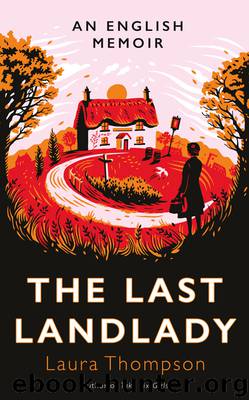
Author:Laura Thompson [Thompson, Laura]
Language: eng
Format: epub
ISBN: 9781783525034
Publisher: Unbound
Published: 2018-07-24T16:00:00+00:00
Miss Potterson, sole proprietor and manager of the Fellowship Porters, reigned supreme on her throne, the Bar, and a man must have drunk himself mad drunk indeed if he thought he could contest a point with her.
A landlady, indeed. Not one to arouse the customers’ swooning love, but one whose ability to command veneration is beyond any doubt.
Throughout the Dickensian era, drinking establishments were acquiring other recognisable traits: the counter; the separate bars with their different prices and atmospheres; the windows with their soft dimples and fruit-gum colours, their white lettering framed and fretted like ice sculpture; the glow that envelops and hallows. The pub was emerging – it was becoming, as it seemed, what it had always been meant to be. It had evolved from alehouses, taverns and inns, from coffee houses and gin palaces; all of these had aspects of the pub. The alehouse, the oldest of the lot, was about drinking, impure and simple. The inn, fully established by around the late twelfth century, provided food, drink and accommodation. The tavern was for food and drink, possibly including wine, very popular in London from the thirteenth century. These strands were not always distinct from each other – for instance an alehouse might offer some basic food, rather in the manner of my grandmother’s giant chunk of Cheddar; a tavern might have a few bedchambers – but the three types of establishment were given separate status in legislation.
They were too as clearly distinguished in people’s minds as a gastropub from a Harvester. Alehouses were the bottom of the pile and as unavoidable as rats: at the start of the fourteenth century there were more than 1,300 in the City of London alone, as compared with around 350 taverns, and a 1577 survey of England and Wales recorded more than 14,000 alehouses. Two hundred had been suppressed in London just before this survey was taken: another attempt to do something about drunkenness, and completely hopeless as they continued to proliferate. People wanted them. They were generally small and basic, sometimes barely businesses at all, sometimes brothels on the side. More often than not they were like the worst kind of pubs, in which the desire for alcohol was unclothed by joy and subtlety, and the solace on offer was that of mere oblivion.
Inns, by contrast, stood proud and respectable. They were pub-like in their centrality, not just to their own community but to the life of the nation. Although their first function was as stopping places for travellers, they were often much more besides. Rather like the giant shopping malls of today, which one really need never leave since everything is in them, inns might be post offices, auction houses, holders of goods (some had warehouses in their yards), business centres, employment agencies and places where wages were allocated at ‘pay tables’. They might be debating chambers, meeting places for elections or trade associations. They might hold dances, banquets, inquests, cockfights. They might be entertainment venues. By the late
Download
This site does not store any files on its server. We only index and link to content provided by other sites. Please contact the content providers to delete copyright contents if any and email us, we'll remove relevant links or contents immediately.
Waking Up in Heaven: A True Story of Brokenness, Heaven, and Life Again by McVea Crystal & Tresniowski Alex(37925)
Still Foolin’ ’Em by Billy Crystal(36471)
Cecilia; Or, Memoirs of an Heiress — Volume 1 by Fanny Burney(32724)
Cecilia; Or, Memoirs of an Heiress — Volume 2 by Fanny Burney(32090)
Cecilia; Or, Memoirs of an Heiress — Volume 3 by Fanny Burney(32068)
Fanny Burney by Claire Harman(26730)
Empire of the Sikhs by Patwant Singh(23206)
We're Going to Need More Wine by Gabrielle Union(19173)
Hans Sturm: A Soldier's Odyssey on the Eastern Front by Gordon Williamson(18725)
Plagued by Fire by Paul Hendrickson(17541)
Out of India by Michael Foss(17022)
All the Missing Girls by Megan Miranda(16724)
Cat's cradle by Kurt Vonnegut(15558)
For the Love of Europe by Rick Steves(14923)
Pimp by Iceberg Slim(14800)
Molly's Game by Molly Bloom(14261)
Bombshells: Glamour Girls of a Lifetime by Sullivan Steve(14220)
Leonardo da Vinci by Walter Isaacson(13521)
4 3 2 1: A Novel by Paul Auster(12624)
